
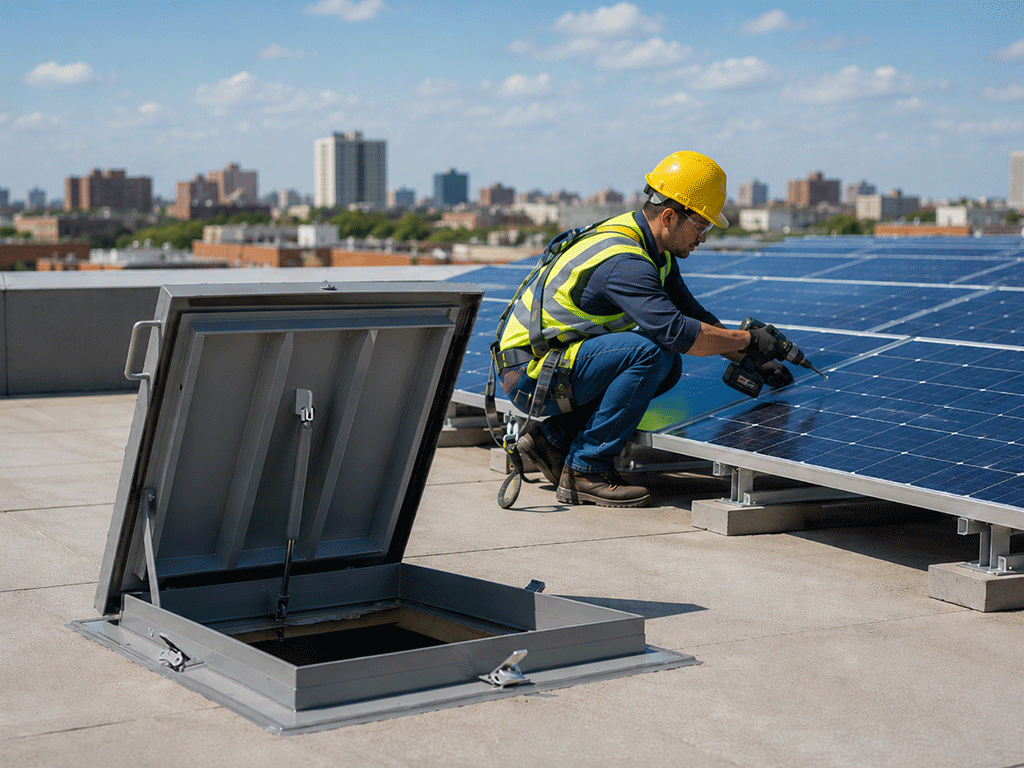
Roof access doors support solar, EV, and expanding energy infrastructure by giving maintenance teams and engineers safe, code-compliant entry points needed to install, inspect, and service the growing range of energy systems now operating on commercial rooftops.
Today’s commercial buildings carry more rooftop infrastructure than ever. Solar arrays, upgraded HVAC systems, EV-related electrical conduits, and battery storage units are all becoming standard features of modern facilities. As a result, the access points serving those systems can no longer be an afterthought.
With that in mind, we’ll cover how commercial roof access doors support solar maintenance, EV charging infrastructure, worker safety, code compliance, and long-term building functionality.
Why Are Rooftop Solar Systems Driving Greater Demand for Roof Access Points?
Rooftop solar systems are driving greater demand for roof access points because solar arrays require regular inspection, cleaning, and repair that can only be done safely with a permanent, secure access point.
Commercial solar adoption has grown significantly. According to the Solar Energy Industries Association (SEIA), rooftop commercial solar capacity has grown at a 12% compound annual growth rate (CAGR) over the past five years. In 2024 alone, the commercial segment installed 2,118 MWdc of new capacity, which was an annual record and an 8% increase over 2023.
This growth translates directly to more rooftop service activity. And each installation requires a reliable solar roof access point that keeps service visits fast, safe, and repeatable across a system’s lifespan.
How Do Roof Access Doors Simplify Maintenance for Rooftop Energy Equipment?
Roof access doors simplify maintenance for rooftop energy equipment by providing a fixed entry point that allows technicians to reach HVAC units, solar inverters, electrical systems, and battery storage quickly and safely.
This matters across two distinct scenarios.
Routine Inspections
Every rooftop system in a building has a service schedule, and having a well-positioned commercial roof hatch streamlines routine visits.
Technicians can arrive, access the roof, complete the work, and leave. No setup delays or improvised entry points.
Emergency Repairs
Response time becomes crucial when an inverter goes offline, a conduit seal fails, or storm damage needs immediate assessment.
A permanent roof access door allows the technician to reach the problematic system in minutes rather than spending time locating and setting up temporary equipment. This in turn reduces system downtime and the revenue loss that often comes with it.
Working through the specification process for a commercial rooftop project? Browse our resources for practical guidance on selecting and installing the right access solutions.
What Role Does EV Charging Infrastructure Play in Increasing Rooftop Access Needs?
EV charging infrastructure increases rooftop access needs because the electrical conduits, transformer upgrades, and utility connections that support EV chargers often run through or terminate at the roof level.
EV adoption continues to reshape commercial building requirements. The International Energy Agency (IEA) reports that the US expanded its public charging stock by 20% in 2024, bringing the total to just under 200,000 public charging points. In addition, 12 states and 53 local governments have added EV provisions to their building codes, local ordinances, and zoning requirements as of December 2024.
These numbers will continue to climb, with a growing share of the electrical infrastructure supporting those chargers running through commercial buildings.
As a result, service access to rooftop electrical termination points, conduit runs, and utility connections has become a maintenance requirement not just during installation, but throughout the life of the building.
Want to stay ahead of what’s shaping commercial construction and energy infrastructure projects? Explore our Industry Insights to get the latest trends and analysis.
How Do Commercial Roof Access Doors Contribute to Worker Safety and Code Compliance?
Commercial roof access doors contribute to worker safety and code compliance by providing a standardized entry point that helps facilities meet OSHA and building code requirements for rooftop work.
Rooftop work carries real risk. According to OSHA, falls are the leading cause of death in construction in the U.S., and ad-hoc access methods like portable ladders and improvised openings increase that risk on every use.
Let’s look at the requirements that define what compliant rooftop access looks like.
OSHA Fall Protection Requirements
Two OSHA standards apply to rooftop work depending on the type of activity:
- 29 CFR 1910.28: This covers routine maintenance tasks like inspecting HVAC or solar systems. Under this standard, employers must protect workers from falls at heights of 4 feet or more. When work is performed within 6 feet of the roof edge, a guardrail system, safety net, travel restraint system, or personal fall arrest system is required.
- 29 CFR 1926.501(b)(1): For construcztion-level work, the standard raises the fall height to 6 feet above a lower level.
A commercial roof access door addresses these requirements at the entry point, which is the first and most critical stage of every rooftop visit. Hatches with integrated grab handles, self-latching lids, and anti-slip surfaces reduce fall risk the moment a technician transitions from ladder to roof.
Building Code Compliance
The International Building Code (IBC) Section 1011.12.2 requires that in buildings without an occupied roof, access to the roof shall be provided by a roof hatch or trap door not less than 16 square feet in area with a minimum dimension of 24 inches (2 feet).
Where the hatch opening is located within 10 feet of the roof edge, guards must be installed in accordance with IBC Section 1015.
Specifying a commercial roof hatch that meets these requirements from the start prevents costly retrofits, avoids failed inspections, and keeps your project on schedule.
Note: Local authorities having jurisdiction (AHJs) may adopt amendments to the IBC, so always verify local code requirements before starting a project.
Looking for in-depth guidance on compliance, product performance, and access planning? Visit our Knowledge Hub for resources built around the questions contractors and facility managers ask most.
What Features Should You Look for in a Commercial Roof Access Door for Energy Infrastructure Projects?
For energy infrastructure access points, look for commercial roof hatches that are weather-resistant, thermally insulated, corrosion-resistant, secure, and rated for high-traffic maintenance use.
Weather Resistance
Commercial rooftops often experience harsh weather. As a result, your roof access door needs tight seals, effective drainage design, and waterproofing at the frame-to-roof interface to protect the building’s envelope.
Thermal Insulation
An uninsulated roof hatch can be a point of heat loss in winter and heat gain in summer. Look for insulated doors that meet your local energy code requirements.
Corrosion Resistance
Rooftop hardware is often exposed to UV radiation, temperature cycling, precipitation, and in coastal or industrial areas, corrosive airborne particulates.
Aluminum, galvanized steel, and stainless steel are appropriate materials for long-term commercial applications. Avoid products with exposed ferrous components, as they’ll rust and weaken over time.
Security
Rooftop energy infrastructure has monetary value, with solar panels, inverters, and electrical equipment ;all targets for theft and vandalism. A commercial roof access door with a keyed locking mechanism limits rooftop equipment access to authorized personnel only.
Load Ratings and Sizing
High-traffic maintenance use puts repeated mechanical stress on roof hatches. Confirm that the product you specify carries a load rating appropriate for the number of service visits expected over the system’s lifespan.
Sizing also matters. Ensure the clear opening dimensions can accommodate the tools and equipment your maintenance teams will carry through the hatch.
FAQs on Commercial Roof Access Doors
1. How often should roof access doors be inspected when supporting solar or HVAC systems?
Roof access doors should be inspected at least annually, and ideally, aligned with each scheduled maintenance visit for the equipment they serve.
Each inspection should verify that:
- Seals and weatherstripping are intact.
- Hinges and locking hardware operate smoothly.
- The frame-to-roof interface shows no signs of water infiltration.
- The opening area is clear of debris.
2. Can a standard roof hatch be used for solar panel installation projects, or do I need a commercial-grade access door?
For a commercial solar project, a commercial-grade roof access door is the appropriate specification. Commercial installations involve repeated, high-frequency access by multiple service personnel carrying tools and equipment, often over the system’s lifespan. Residential or light-duty products aren’t rated for that level of use.
Commercial roof access doors also meet the structural, insulation, and weather resistance requirements that apply to commercial building codes. As a result, specifying a standard product on a commercial project creates compliance risk and increases the likelihood of premature failure.
3. Do roof access doors need to meet specific codes for commercial buildings with EV charging or solar installations?
Yes. At minimum, commercial roof access doors must meet IBC Section 1011.12.2 requirements for size (not less than 16 square feet with a minimum 24-inch dimension) and guard requirements when located within 10 feet of the roof edge. OSHA fall protection standards also apply to the workers using those hatches.
In jurisdictions that have adopted EV or solar provisions into their local codes, additional requirements may apply to the electrical infrastructure that those systems connect to. Always verify requirements with the AHJ during the design phase.
To Sum It Up
As commercial rooftops take on more energy infrastructure, the access points serving those systems need to be just as well-planned as the systems themselves.
Commercial roof access doors that are properly specified for weather resistance, insulation, security, corrosion resistance, and code compliance reduce service time, protect worker safety, and support the long-term reliability of the systems they serve.
Access Solutions Hub is here to support your research and planning process. However, when a project involves specific product configurations, compliance questions, or tight deadlines, speaking directly with a specialist will get you on the right track faster.
For product-specific guidance and up-to-date specifications, reach out to Best Access Doors, our trusted partner, at 1 (888) 655-3711 to get expert advice.